How is public funding for the performing arts distributed across Europe? Does high-quality culture truly reach everyone, regardless of whether they live in cities or rural areas?
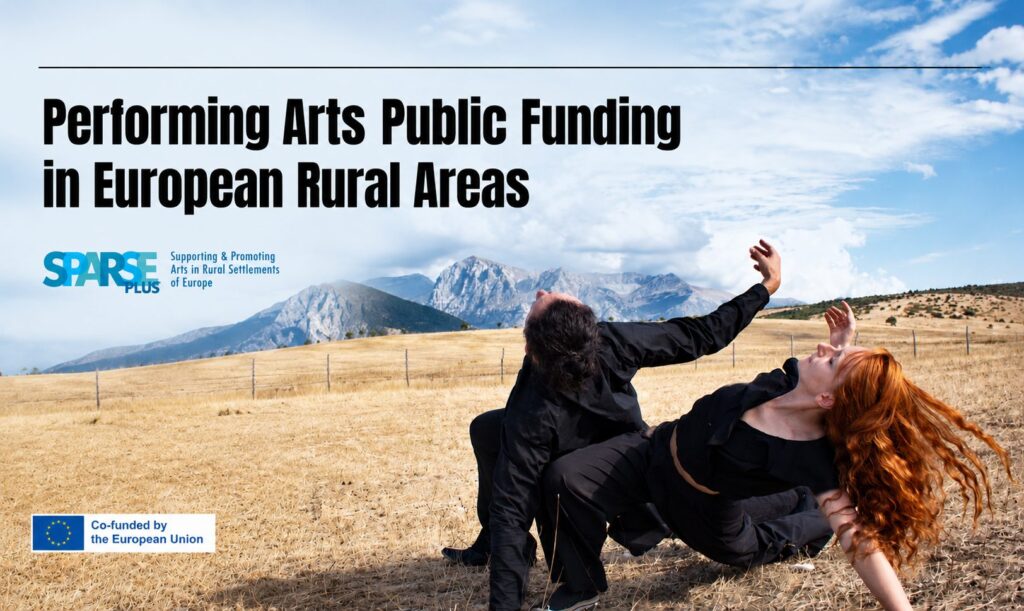
These questions are addressed in the newly published European study Public Funding for the Performing Arts in European Rural Areas, produced as part of the SPARSE Plus project, co-funded by the Creative Europe programme.
The study was prepared by Chloe Sustainability in collaboration with the SPARSE Plus project partners. Nová síť coordinated the project’s research activities and contributed to the publication, which represents one of the project’s key research outputs.
For the first time, the publication provides a systematic overview of how public funding for the performing arts reaches rural areas across Europe. Alongside an analysis of available data, it also offers recommendations that can help create fairer cultural policies and improve access to professional performing arts beyond major urban centres.
The findings reveal that predominantly rural regions consistently receive the smallest share of public funding for the performing arts, despite being home to a significant proportion of Europe’s population. The study also highlights differences between artistic disciplines: while music is more commonly available in rural areas, theatre and dance remain considerably less accessible.
The research further shows that the main challenge often lies not in the funding rules themselves, but in the conditions under which cultural organisations outside major cities operate. The costs associated with mobility, coordination, and hosting cultural events create barriers that current funding systems often fail to address adequately. The study therefore emphasises the importance of networks that support cultural mobility and puts forward concrete recommendations for the future design of public funding policies.
“Culture should not be concentrated only where the strongest financial structures exist. Rural communities are places of creativity, participation, and innovation, and public funding systems should recognise and reflect their value and potential accordingly.”
Adriana Světlíková, Director of Nová síť, one of the partners of the SPARSE Plus project.
Nová síť has long been committed to supporting culture in the regions, strengthening cooperation between cultural organisations, and advocating for equal access to high-quality arts and culture. The findings of this study provide an important foundation for further professional debate and for the development of cultural policies at both the national and European levels.
Further Information:
The full study, Public Funding for the Performing Arts in European Rural Areas, is available on the SPARSE Plus project website: https://www.sparse.eu/risorse/performing-arts-public-funding-in-european-rural-areas/
The press release accompanying the publication of the study can be found here: https://www.sparse.eu/new-european-report-reveals-how-public-funding-reaches-rural-performing-arts/